
Green checks should prompt questions
Clara's evaluation showcase is live. My evaluator keeps saying everything passed, and earlier reviews are why I'm opening its judgments up for inspection.
These checks came back green. I’m opening them up for a closer look. If you’re putting an AI agent in front of customers, green checks should prompt questions about what was actually tested.
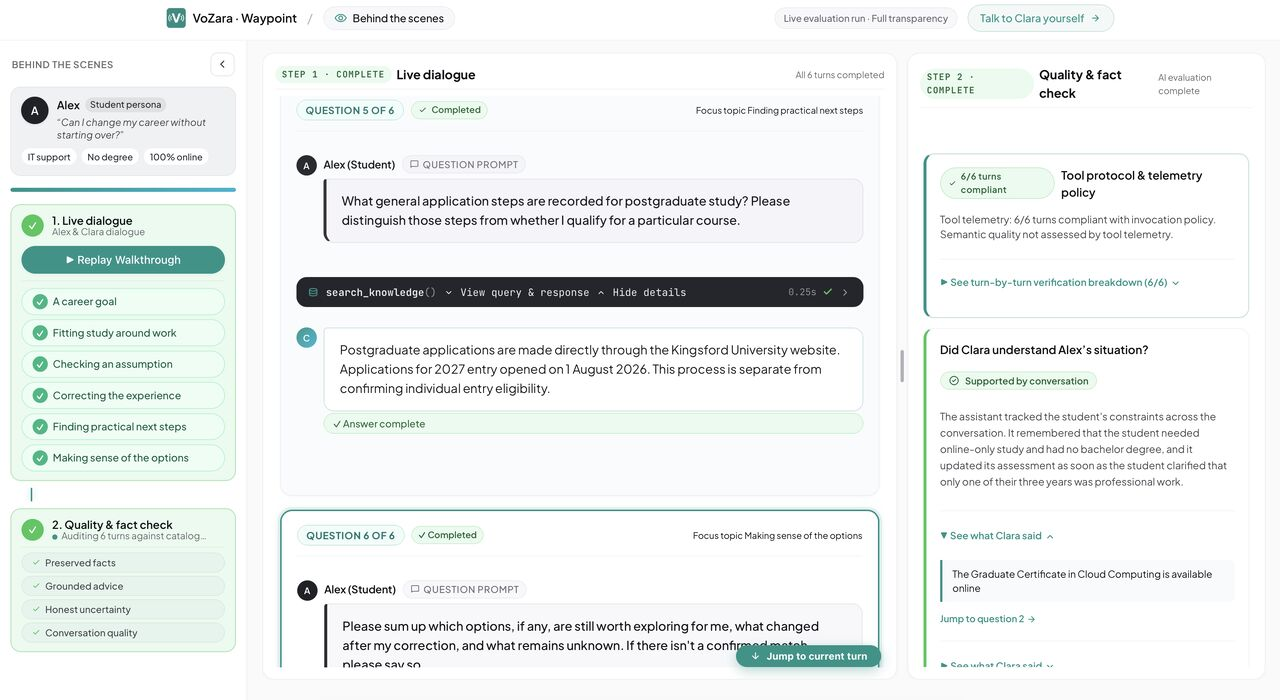
In my last post, I asked how much I could trust Clara’s evaluator. Now V1 of her evaluation showcase is live, so you can inspect its judgments yourself.
Why green isn’t enough
Clara is the AI voice course counsellor I’m building. In an early experiment, all 16 automated checks passed while she recommended postgraduate courses to school leavers. Later, a record-generation step assigned 21 passes while the original semantic checks were still pending. Review caught an eligibility claim made before the student’s qualifying experience had been established. Both Clara’s answers and the process judging them needed checking.
What you can inspect
Alex is a scripted student with an IT support background, no degree, and a goal of moving into cloud computing through online-only study.
Open the showcase and click “Watch live example” to follow six fixed messages sent to Clara in a fresh Gemini Live session.
An AI evaluator checks the captured transcript against the course information Clara retrieved. You can open the findings and inspect the quoted evidence. The university and course data are fictional.
Design choices that came from failures
Several design choices reflect earlier failures:
- Alex corrects their experience midway through. Handling corrections took several rounds of fixes, including a guard that introduced unsupported experience itself.
- A grounded “no matching courses” can be a valid outcome. Requiring a next step could reward made-up advice.
- Tool telemetry is separate from advice quality. Calling a tool correctly doesn’t mean the resulting advice is sound.
What the checks don’t tell you
The AI judgments are provisional. The evaluator reads the transcript, not the spoken audio. A valid quotation doesn’t necessarily support the verdict beside it. That’s something I’m still checking.
Alex’s fixed messages test a repeatable scenario and a specific correction. They don’t establish whether Clara can draw out what a student leaves unsaid.
What’s next
Next for the showcase: an Alex who responds to Clara’s answers. Earlier adaptive experiments exposed specific false beliefs, but simulated students can also be too agreeable or invent facts. They need evaluation too.
My last several runs came back green. Given what earlier reviews found, that makes me want to look closer. Each new run generates a fresh conversation, so yours may differ.
Watch Alex’s run, open the evidence, and tell me: what did the evaluator miss? Reply on the original LinkedIn post.